

Our models of care
The Queensland Ambulance Service (QAS) offers a range of models of care to ensure you get safe and appropriate support. When you call Triple Zero (000), trained medical staff will guide you to the right care, in the right place, at the right time.
In addition to immediate ambulance response for critical patients, our models of care include:
- QAS Clinical Hub
- Mental Health Co-Responder Program
- Mental Health Liaison Service
- QAS Falls Co-Response Program
- Complex Care Team
Learn more about each program below.
QAS Clinical Hub
The QAS Clinical Hub works to ensure you receive the most appropriate and timely healthcare after you’ve called Triple Zero (000). It is home to a multidisciplinary team made up of senior paramedics, specialist doctors, registered nurses, mental health and social workers, occupational therapists, and physiotherapists. The team monitor patients as a secondary triage and healthcare navigation service to make sure you get the right care at the right time.
Mental Health Co-Responder Program
This program gives you expert support if you are experiencing a mental health crisis by pairing a QAS senior paramedic with a senior mental health clinician from the mental health service in your local Hospital and Health Services.
Since starting as a pilot program in South East Queensland in 2019 this program has been rolled out to over 20 sites across Queensland, including districts in Cairns, Townsville, Mackay, Central Queensland, Sunshine Coast, Metro North, Metro South, West Moreton, Gold Coast, Darling Downs and Wide Bay.
Mental Health Liaison Service
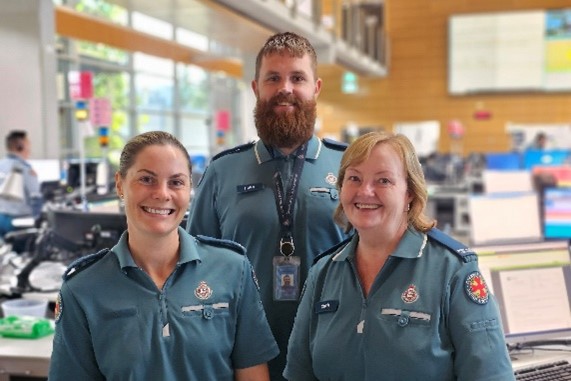 Our Mental Health Liaison Service (MHLS) means we have a QAS senior mental health clinician in the Brisbane Operations Centre to provide information, advice and assistance to Triple Zero (000) callers, supervisors, managers, and paramedics across the state.
This allows us to make sure the right resources are available to you during a mental health crisis, while also giving support to the paramedics that are sent to help you to give you the best care possible.
The MHLS also provides direct clinical support if you are experiencing a mental health crisis via telehealth (over the phone), helping with:
- de-escalation
- risk assessment and management
- advice and education on symptom management
- referral to support services.
QAS Falls Co-Response Program
This program helps if you have had a fall at home or in an aged care facility. A QAS senior paramedic and an allied health clinician (occupational therapist or physiotherapist) respond to your Triple Zero (000) call together.
They use a specially-equipped vehicle with patient lifting tools. The paramedic assesses your physical condition, while the allied health clinician looks at your home environment, social supports and physical needs. They also help reduce your risk of future falls and connect you with local services.
The program currently operates in Cairns, Townsville, Sunshine Coast, Gold Coast and Metropolitan Brisbane.
Complex Care Team
The Complex Care Team provides compassionate and comprehensive support for our most vulnerable community members and those with complex needs.
The team works with these identified patients to understand their needs and connects them to appropriate care and support services, helping to manage complex conditions and to stay well. Team members are based in local regions to make sure they have a strong connection with the local services available.