

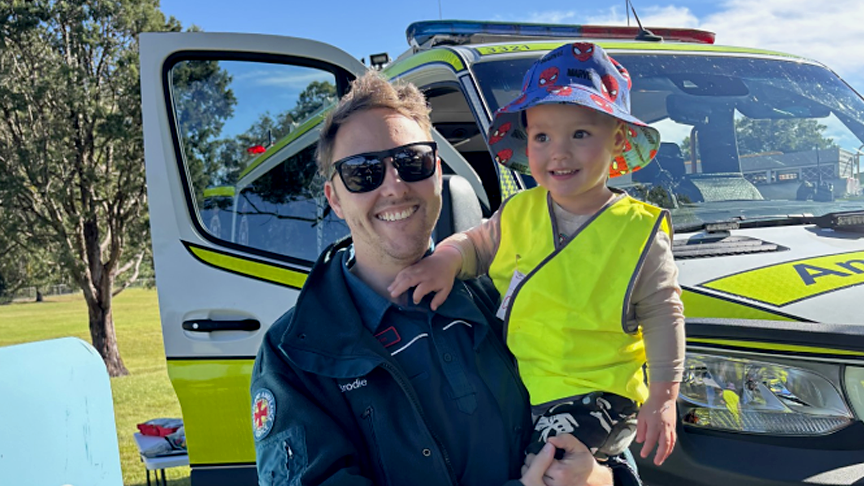
He might be younger and fresh-faced, but Brodie Savage is the first to admit he isn’t chasing the adrenalin-fuelled aspirations of a high acuity Critical Care Paramedic (CCP) role.
Instead, his heart lies in his local community in the rural town of Nanango, where he’s the Officer in Charge (OIC).
Brodie’s move to Queensland Ambulance Service as a graduate was unintentional – more the result of QAS being the first service responding to his application after graduating with a paramedicine degree.
“I grew up in Port Macquarie, and was posted to Nanango straight after uni, so my career started here,” said Brodie.
“I met my wife Ashlee here too as she’d been working as a nurse at Nanango Hospital.
“One of my workmates, Danny George, convinced me to start up a conversation and ask her out on a date – and the rest is history!”
After settling into his role at Nanango, Brodie was then transferred to Bundaberg Station, so both Brodie and Ashlee packed their bags and moved, ready to spend their next several years there.
“Bundy is a great town, and we really enjoyed living and working there,” he said.
But then COVID19 played its card.
The couple’s time in Bundaberg was cut short after Brodie’s Gold Coast-based grandfather experienced multiple health emergencies, and COVID19 travel restrictions meant Brodie was the only family member with the access to support him.
So the couple packed their bags again, this time moving to the Gold Coast.
Brodie gained a transfer on compassionate grounds to Springfield Station, while Ashlee transferred to the Gold Coast University Hospital (GCUH) as a clinical nurse in the infectious diseases and COVID19 ward.
Thankfully for the couple, the COVID restrictions at the time didn't manage to derail their wedding plans, as Brodie and Ashlee were still able to celebrate their marriage on Ashlee’s family property.
During this time, Brodie and Ashlee married on Ashlee’s family property.
After a year of working in Southeast Queensland, the couple realised metro life wasn't for them – it was too busy, they never saw each other and they felt it wasn’t the place for them to raise children.
“Working in a Metro area during that time was hectic and challenging – there was so much disconnect – you’d turn up, do your shift, then go home.”
Brodie said his return to Nanango Station took much longer than they’d hoped – almost four years.
“We needed the extra family supports around us as we’d had our first child and had a second on the way,” he said.
“I’d been driving back and forth from Brisbane while I waited for a job to become available here and that was hard on Ash.
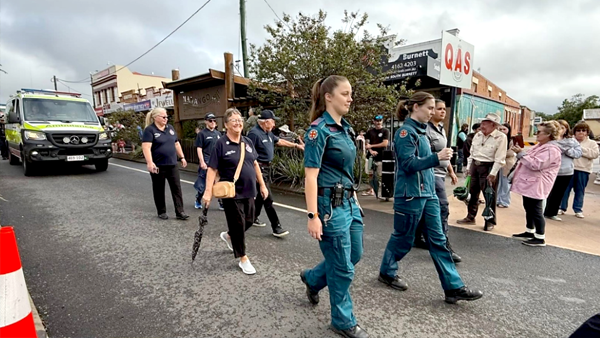
Brodie said in 2024 he jumped on the opportunity to finally return to Nanango Station as a paramedic before taking on the Acting OIC role for 14 months until it was made permanent.
“Returning to the Nanango community completely renewed my love for being a paramedic,” Brodie said.
“I also recognised how important connection to our community was to me both professionally and personally.
“I’ve spent a lot of time with our LAC, which comprises around 10 volunteers of all ages, as their focus has changed significantly over the last few years, from fundraising for equipment for the station and staff, to providing community education and engagement.
“This new direction has given our LAC real purpose and value, and the team is super enthusiastic about it.
“I’ve been working closely with our LAC, supporting the members with training to deliver various education programs including first aid, snake bite first aid, STOP the BLEED, and CPR Awareness.
“These volunteers have also become peer trainers and community coordinators, which means they can become more involved in the school visits and events like Under 8s Days.
“It’s these opportunities you often don’t have the time to do in Metro areas that make us feel a part of the community and that we’re giving back to it.”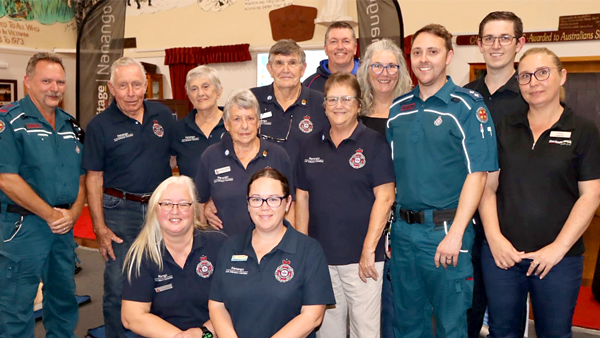
Brodie said the station’s engagement with the local schools, with the area’s disaster planning groups and the emergency services groups had continued to build the station’s community networks and the whole team’s connection with community.
“These community networks have generated other collaborative opportunities too,” he said.
“For example, our Automated External Defibrillator (AED) Project was formed from a partnership between the Heritage Bank, our LAC and the QAS.
“So far, this project has delivered 18 AEDs to the care of community groups and businesses around town, with the aim of reducing the rate of out of hospital cardiac arrest deaths in the area,” Brodie said.
“We’ve also held several community education sessions teaching these groups and community members how to use these AEDs.
“Not all AEDs are in boxes on walls – several units are based with the groups hosting park run or tai chi, but they’re all registered with the QAS so they can be easily located.”
Brodie said he enjoyed living in the community he serves but acknowledged he and the team were highly visible in the community.
“Being visible is just part of the job,” he said.
“I certainly never realised how far-reaching the OIC role would be – there’s so much more to it than rostering and timesheets.
“I don’t think I realised until I was in this OIC role how closely we work with our LACs, and the vital work they do representing QAS in our communities.
“The community education these volunteers provide gives us more time to be out on the road responding to our communities’ emergencies.
“These volunteers help us build community connections and networks. “In general paramedics are constantly looking for ways to improve to bring greater value or purpose to their job.
“Some of us will choose to upskill to be a Critical Care Paramedic (CCP) a Local Area Assessment and Referral Unit (LARU) or High Acuity Response Unit (HARU) to provide more specialist care for their patients.
“Others, like me, may feel we can bring greater value and purpose to our roles by strengthening our stations’ connection to, and engagement with, our local communities.”