

Imagine you’re standing in one of Queensland’s largest tourism cities – our “Glitter Strip” the Gold Coast – it’s 2018 and the traffic is bumper to bumper, the vibe is light and festive despite the crowds, and people from all over the world are soaking up the Commonwealth Games atmosphere…
But nearby, a lady drops to the ground, she’s clearly in trouble, and those around her all react. Someone calls Triple Zero (000) while others kneel beside her to help her.
Within a few minutes you can hear the hum of nobbly bike tyres heralding the arrival of cyclists … a couple of paramedics... on bikes…
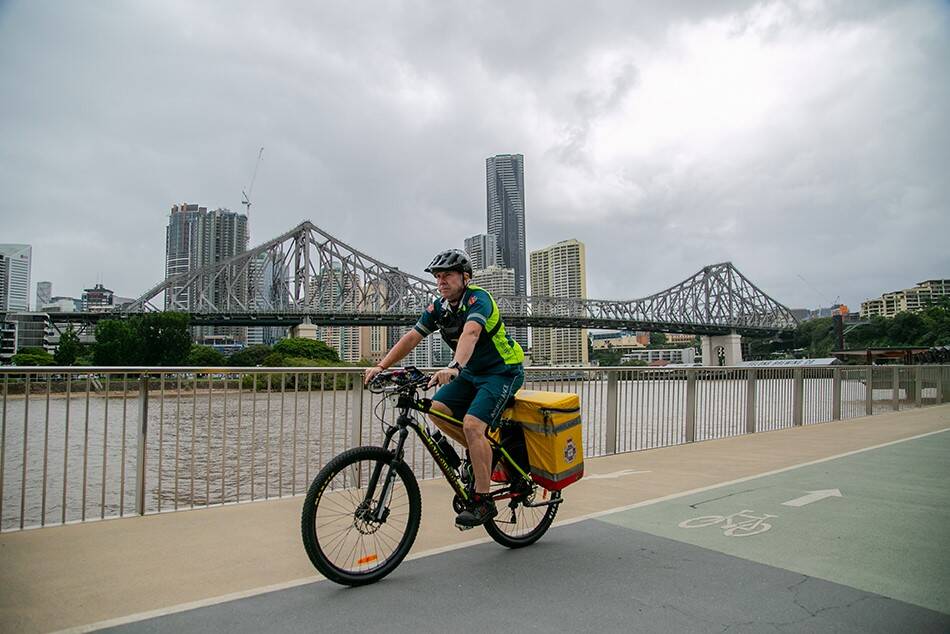
Queensland Ambulance Service’s (QAS) Bicycle Response Team (BRT) was formed in November 2017 to boost our response to the Gold Coast 2018 Commonwealth Games (GC2018) but they’ve proved so valuable to our response, one of our first mountain bikes has been included in the Wynnum Ambulance Museum’s collection as a valued piece of our history.
QAS Heritage and History Manager Mick Davis said these bikes allowed QAS paramedics to reach patients quickly without having to negotiate traffic snarls, closed roads, or pedestrian-only areas.
“The GC2018 Festival Zones attracted large crowds, and the introduction of our BRTs significantly boosted our ability to respond to emergencies,” Mick said.
“The BRTs proved such a success that a second BRT unit was established in Brisbane in 2018, based at the Spring Hill Station to respond to patients in the CBD.
“This bike has a place in our museum because it represents not only a different form of transport, but also reflects our service’s ability to think outside the box to ensure continuity of care even during the really busy times.”
Spring Hill Station BRT paramedic Andy Zieren said QAS research has found since their introduction, the BRTs reached their lower acuity patients in busy pedestrian areas much faster than the on-road teams at least 80 per cent of the time.
“Our BRTs are often sent to the lower acuity CBD patients to free up the on-road teams to treat and transport the higher acuity patients,” Andy said.
Currently the Gold Coast has a core team of four paramedics (two teams of two) on the same or alternating shifts but can expanded to include nine team members when required for major events.
Spring Hill runs a team of two officers each day apart from Mondays, when it has two teams out on our roads.
Andy is one of the said he joined the Brisbane team when it was established.
“I absolutely love being a BRT paramedic,” he said.
“I feel extremely privileged to have what I believe is the best job in the world – I get to help people in their time of need and ride a bike and get paid to do it!
“I have always enjoyed riding - it’s a great way to stay fit and see the world at a rate that’s a bit faster than walking or running. Doing it for work? Absolute bonus.
“I think when we started, there was a real desire to get on scene as quickly as possible, just like going lights and sirens in an ambulance, but this was potentially unsafe for both pedestrians and the paramedics attending.
“So now we remember we need to attend at a sensible pace, not just for our own safety, but for other road/pedestrian access users, and also so we’re not absolutely gassed by the time we get to the patient.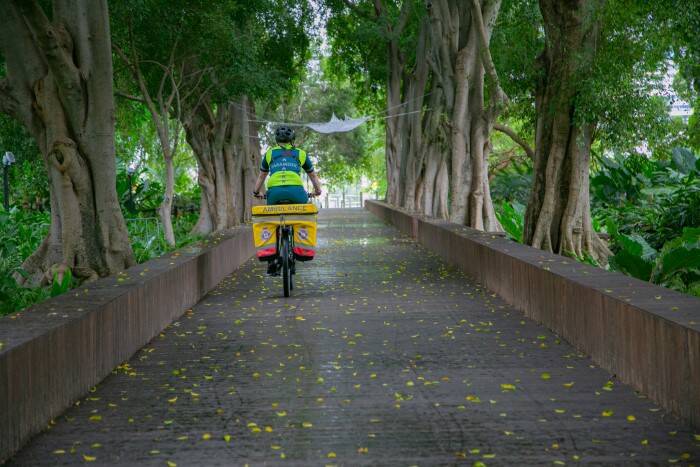
“The difference in time between rushing to get somewhere and going at a more appropriate pace is negligible, and allows us to provide better patient care.”
Andrew said BRTs were still a bit of a novelty when seen out and about.
“Despite the Brisbane BRT having been in operation for nearly seven and a half years, we will hear at least once a day, ‘Is this a new thing? What a great idea!’.
“And the look of surprise on people’s faces when we tell them we’re on a pushbike after attending them (obviously if they haven’t seen the bike we turn up on) is always priceless - we provide the same level and detail of care as paramedics as those driving ambulances, so it’s always complimentary, especially when we’re told ‘Gee, you got here fast!’
“It is a really rare thing to have anyone appear to be dismissive or derogatory to us just because of our mode of transport and I think that speaks to our level of skill and professionalism we treat our patients with.”
Andrew said both stations now have an established training package for new officers, and while our officers require no extra skills, those with the extended scope of practice skills of the Lower Accuity Response Unit (LARU) were always desirable in the teams as they add value to patients’ service who may not need transporting.
“A lot of the skills and training are developed out on the job, and you also pick up a lot of knowledge of addresses, fastest routes and get to know some of our more frequent patients.
“Otherwise, our tier training and clinical professional development requirements remain the same everyone else’s.”
Both home base stations have specially equipped transport vehicles for their BRTs which could deliver or collect teams at the start of a shift, for a special event, or if the bike (or a team member) needed fixing.
“We don’t call it a “sag wagon”,” Andrew laughed. “I had to ask my far more experienced cycling partner what that was, so that may change.”
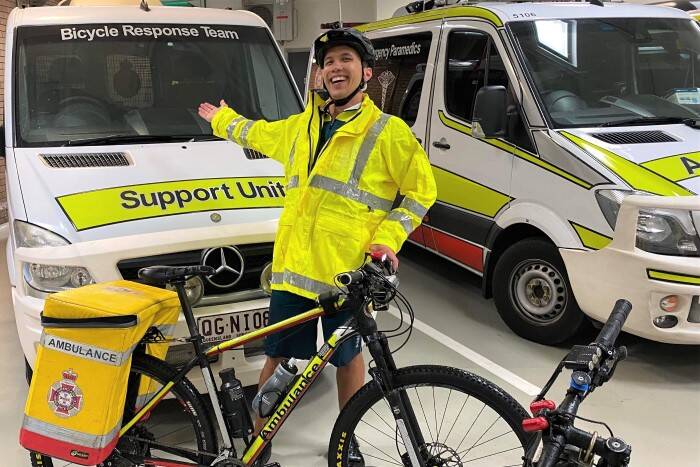
About these bikes...
Bike Models
(These bikes are regular mountain bikes.)
- 2018 – 2022 - Merida Big.Seven and Big.Nine (on display)
- 2022 – present – Norco Fluid 29”er
Carrier kit:
- Bikes are fitted with red and blue flashing lights front and rear.
- Initially a rear cage with two soft panniers
- The soft panniers were replaced with a single custom-made pannier which cover the back of the bike
- Standard paramedic pack weighed around 35kg, while Critical Care Paramedics' (CCPs) kits were slightly heavier with extra equipment and medication.
Distances travelled
- Weekday average 20-30km per day
- Weekends up to 40km per day