

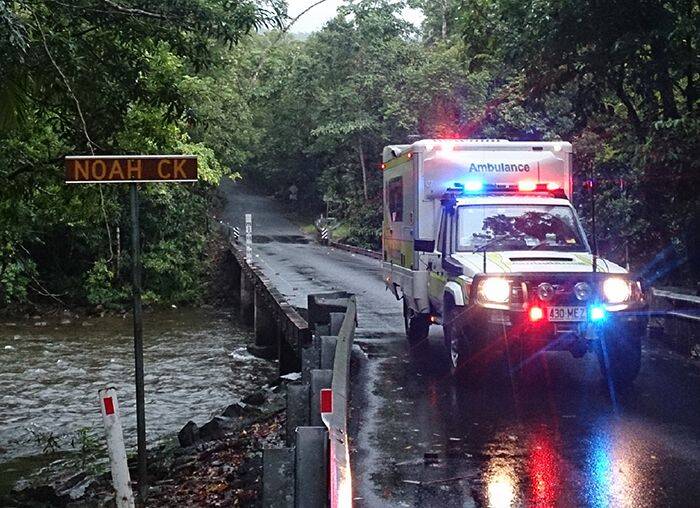
Queenslanders are a resilient lot; now we have the stats to back it up.
Be it fire, flood, cyclone or storm – Queensland is officially the most disaster-prone state in Australia, having experienced more than 100 officially-declared disasters in the past decade. Responding to these disasters occurs by central coordination and support, with services delivered at a local level.
After each ‘High Risk Weather Season’ (officially October – April) the QAS takes a lessons-based approach to how we can continue to improve our operations. Last year’s floods in Townsville and Ingham saw the second largest deployment of staff in the history of the QAS, second only to Cyclone Yasi in 2011, and provided significant opportunities for learning and improvement.
“We learnt a lot from the last high risk weather season. This year we’re doing things a bit differently,” said Alex Thompson, Assistant Commissioner Statewide Planning and Coordination.
“People would be aware that the principles of Prevention, Preparedness, Response, Recovery (PPRR) are core to how we respond to disasters in Queensland. In addition, we are heavily focused on taking a lessons-learned approach from last season to how we enact change across Queensland.”
One of those learnings according to Alex, is strengthening frontline officers and supervisors to engage, empower, coordinate, and collaborate at a local level.
“That’s the focus we want to take with each Region, right down to the Officer-in-Charge (OIC) and frontline officer level.
“We want local solutions to local problems - led by the community, so we can support the Region, the District, the Station - but we want it led by them.
“The connection with key local stakeholders, be it the mayor, local business leaders, or our own Local Ambulance Committee’s is what really gets things done during a disaster,” Alex said.
High-risk weather season is already upon us.
Regional Ambulance Coordination Centre (RACC) preparedness exercises are currently underway around the state, and following extensive review, the State Major Incident Disaster (SMID) Plan will be launched before the end of the year.
But Alex said we are also changing the way we deploy emergency and disaster management assets.
“Historically it’s been Brisbane and Townsville that have hosted the majority of these resources. Following from learnings from last year we’re taking a more distributed and local approach where assets will be pre-deployed in three-hour increments along locations down the coast – including Cairns, Townsville, Mackay, Rockhampton, Bundaberg and Brisbane.
“The aim is to have three deployable containers which include the ability to function as mobile clinics, accommodation, and a general-purpose container in each centre.
“Another key learning from last year is that as we deploy staff, they need to be self-sufficient, this includes the potential to accomodate at QAS stations or other suitable locations rather than utilising local accommodation options such as hotels and motels as these are often needed by residents directly impacted by the disaster.”
Central coordination and community buy-in is key.
Former Acting Director, Emergency Management Unit Zoe Henrichs said our disaster-response is centrally coordinated and governed, however the response to any disaster or major event should always be collaborative in nature.
“The Emergency Management Unit and the State Operations Coordination Centre may inform the response through governance, but Regions are best place to provide local intelligence on their risks and barriers and how we can work collaboratively to help mitigate them.”
At an individual level, Alex is calling on all QAS staff, no matter where they’re located, to be disaster-season ready.
“It’s also time for you to prepare yourself.
“All QAS employees are essential workers, and that’s not just paramedics – including administrative and corporate staff, all the way to the teams who help deliver our critical ICT infrastructure - they play a pivotal role in our disaster response, ensuring we support Queenslanders no matter where they live.”
“It’s up to each of us to be ready, to have a plan in place – know how you can be self-sufficient, how will you get to work and how you will ensure you have plans in place to support and caring responsibilities.”
For more information visit:
https://www.getready.qld.gov.au/get-ready-queensland-week-2025